In the amusement industry, the longevity and operational efficiency of rides are fundamental to profitability, safety, and guest satisfaction. The concept of ride service life encompasses the total operational period during which a ride remains safe and economically viable. Equally important is the maintenance cycle, the systematic schedule of inspections, refurbishments, and part replacements that ensure mechanical reliability. Together, these two aspects define the sustainable lifecycle of amusement attractions—from towering steel coasters to the nostalgic swinging pirate ship ride.
Understanding Ride Service Life
The service life of an amusement ride is determined by the interplay of mechanical fatigue, material degradation, and operational intensity. Manufacturers typically specify an estimated design life, often measured in operational hours or cycle counts. However, this figure is influenced by factors such as environmental exposure, frequency of use, and the rigor of maintenance practices.
For instance, a steel roller coaster operating in a coastal environment endures accelerated corrosion due to salt-laden air. In contrast, an indoor dark ride experiences less environmental wear but may suffer from mechanical fatigue due to continuous operation. The diversity of conditions necessitates tailored maintenance planning for each installation.
Service life does not end abruptly; rather, it tapers as structural components reach fatigue limits and replacement parts become scarce. Operators must balance the economic feasibility of continued operation against the capital expense of ride replacement. A proactive life-extension strategy—incorporating regular non-destructive testing and targeted component refurbishment—can defer major overhauls and optimize return on investment.
The Structure of a Maintenance Cycle
A maintenance cycle consists of preventive, predictive, and corrective actions that maintain ride integrity throughout its operational life. Preventive maintenance follows manufacturer recommendations, focusing on routine lubrication, fastener checks, and alignment verification. Predictive maintenance leverages sensor data and trend analysis to anticipate failures before they occur. Corrective maintenance involves reactive repairs following fault detection.
The ideal maintenance cycle integrates all three methodologies into a coherent schedule. This integration ensures minimal downtime while maintaining compliance with local regulatory standards and international safety codes such as EN 13814 or ASTM F2291.
For large-scale rides, maintenance activities are tiered into daily, weekly, monthly, and annual intervals. Daily checks involve functional testing of restraint systems, braking mechanisms, and control logic. Weekly routines cover torque inspections, sensor calibrations, and safety gate interlocks. Annual maintenance often includes full disassembly of key mechanical assemblies and structural testing using ultrasonic or magnetic particle inspection.
Life Cycle Management for Different Types of Roller Coasters
The maintenance requirements and service life expectations vary significantly among different types of roller coasters. Each design—whether steel, wooden, or hybrid—presents unique challenges that influence its maintenance regime.

Steel roller coaster systems, characterized by their precision-engineered track profiles and high dynamic loads, demand meticulous attention to weld integrity and fastener torque. Thermal expansion and contraction cycles induce micro-stresses that can propagate into fatigue cracks if not properly monitored. Regular ultrasonic testing of weld seams and periodic repainting to prevent oxidation are essential for longevity.
Wooden roller coaster, while admired for their classic aesthetics and unique ride dynamics, are inherently susceptible to moisture infiltration and biological degradation. The service life of wooden track sections depends on timber preservation treatments, joint reinforcement, and structural bolt retightening schedules. Operators often employ phased track replacements, maintaining structural authenticity while ensuring continued safety.
Hybrid coaster, combining steel supports with wooden tracks or vice versa, introduce complex interfaces between dissimilar materials. Differential expansion and stiffness variance require specialized inspection protocols and hybrid-compatible fasteners to maintain mechanical integrity.
Maintenance of Flat Rides and Motion Attractions
Beyond coasters, flat rides such as the swinging pirate ship ride require their own maintenance logic. The repetitive pendulum motion imposes alternating tensile and compressive stresses on the support arms and pivot bearings. Bearing lubrication intervals must be tightly controlled to prevent overheating and frictional wear. Rope or chain suspensions require precise tension monitoring to avoid asymmetric loading.
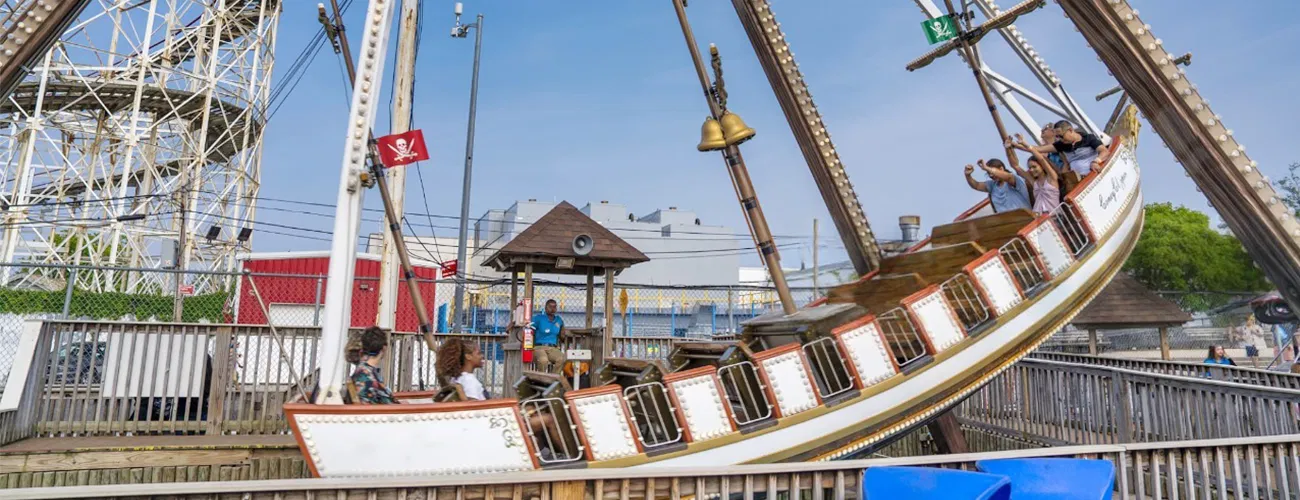
Electrical and hydraulic systems play a pivotal role in motion control and braking. Valve seals, actuator rods, and hydraulic fluids must undergo systematic replacement based on operation cycles. Failures in these systems can lead to uncontrolled motion, making hydraulic integrity inspections a non-negotiable component of the maintenance cycle.
The service life of such a ride can extend beyond three decades when refurbishment programs address structural and mechanical wear in a timely manner. Replacement of obsolete control electronics with modern programmable logic controllers (PLCs) not only enhances reliability but also extends the ride’s operational relevance.
Predictive Technologies and Data-Driven Maintenance
Recent advancements in sensor technology and data analytics have transformed ride maintenance from reactive to predictive. Accelerometers, strain gauges, and temperature sensors embedded in ride components continuously collect performance data. Machine learning algorithms analyze vibration patterns, detecting anomalies indicative of bearing wear or imbalance long before human inspection could identify them.
For high-speed coasters, track-mounted accelerometers can monitor real-time ride dynamics, identifying deviations in smoothness that signal track misalignment or wheel degradation. Cloud-based maintenance management systems aggregate this data, providing operators with a comprehensive view of asset health.
This predictive paradigm not only reduces unplanned downtime but also refines the maintenance cycle. Instead of following rigid time intervals, operators can perform maintenance precisely when conditions warrant intervention—optimizing resource allocation and minimizing waste.
Regulatory Compliance and Documentation
Ride maintenance is governed by stringent safety standards and national regulatory frameworks. Documentation plays a crucial role in verifying compliance. Every inspection, repair, and component replacement must be logged with time stamps, responsible personnel, and test results.
Third-party audits frequently review maintenance documentation to ensure adherence to manufacturer specifications and safety standards. Failure to maintain adequate records can result in operational suspension or revocation of ride certification. Therefore, digital maintenance management systems are increasingly adopted to streamline documentation and traceability.
Moreover, periodic re-certification by competent engineers ensures that structural integrity aligns with evolving safety codes. This continuous validation process is essential for extending ride service life beyond the original design expectations.
The Economic Equation of Longevity
The decision to refurbish or retire a ride is ultimately an economic one. Operators must evaluate maintenance costs, spare part availability, and guest popularity. Extending service life through comprehensive refurbishment can defer capital expenditure, but excessive maintenance spending may erode profit margins.
A balanced approach involves lifecycle cost analysis, comparing the net present value of continued maintenance against the investment required for a new installation. In many cases, modernization—such as upgrading braking systems, repainting structures, or replacing mechanical drives—can yield a refreshed experience at a fraction of replacement cost.
Conclusion
Ride service life and maintenance cycles are inseparable components of sustainable amusement park operations. From the intricate engineering of different types of roller coasters to the rhythmic motion of a swinging pirate ship ride, every attraction relies on precise mechanical stewardship.
Implementing disciplined maintenance cycles, leveraging predictive technologies, and adhering to regulatory frameworks collectively extend operational life and safeguard public safety. Through data-driven decision-making and proactive asset management, operators ensure that their rides continue to deliver both exhilaration and reliability—decade after decade.

請先 登入 以發表留言。